The Cost of Informal Operations
In many field-driven businesses, daily execution depends on informal messaging. Sales representatives coordinate visits, confirm orders, and share payment updates through consumer chat applications, where instructions become buried in threads and updates are repeated across conversations. Managers often piece together activity from screenshots and message history instead of accessing centralized operational records.
The cumulative impact becomes visible when small delays are aggregated across time and teams.
Typical micro-friction includes:
-
5 minutes per rep searching message history
-
3 follow-ups per unclear instruction
-
10 duplicated confirmations per week
-
15 minutes daily reconciling screenshots
When multiplied across 50 representatives, 20 working days, and 12 months, these small delays lead to measurable productivity loss.
Auditability introduces additional risk. If last month’s visits or collections required formal review, the supporting records would likely be dispersed across chat exports and personal devices rather than stored within a system of record. As teams scale, this informal operating layer limits visibility, accountability, and operational control.
Messaging Apps Were Never Built for Execution
Consumer messaging platforms are designed to support conversation flow. Their core structure is chronological and thread-based. Field operations, however, depend on relational data tied to accounts, tasks and measurable outcomes.
Messaging platforms store communication chronologically.
Field operations require information organized by account, task and outcome.
Messaging platforms optimize for response speed.
Field operations require traceability and task ownership.
Messaging platforms generate conversational history.
Field operations depend on indexed records linked to visits, orders, and collections.
Messaging platforms treat updates as messages within a thread.
Field operations treat updates as executable actions recorded within workflow.
When conversational systems are used to coordinate operational work, process structure is replaced by message dependency. Visibility becomes fragmented, and accountability depends on manual follow-up instead of system logic.
Introducing FieldTalk
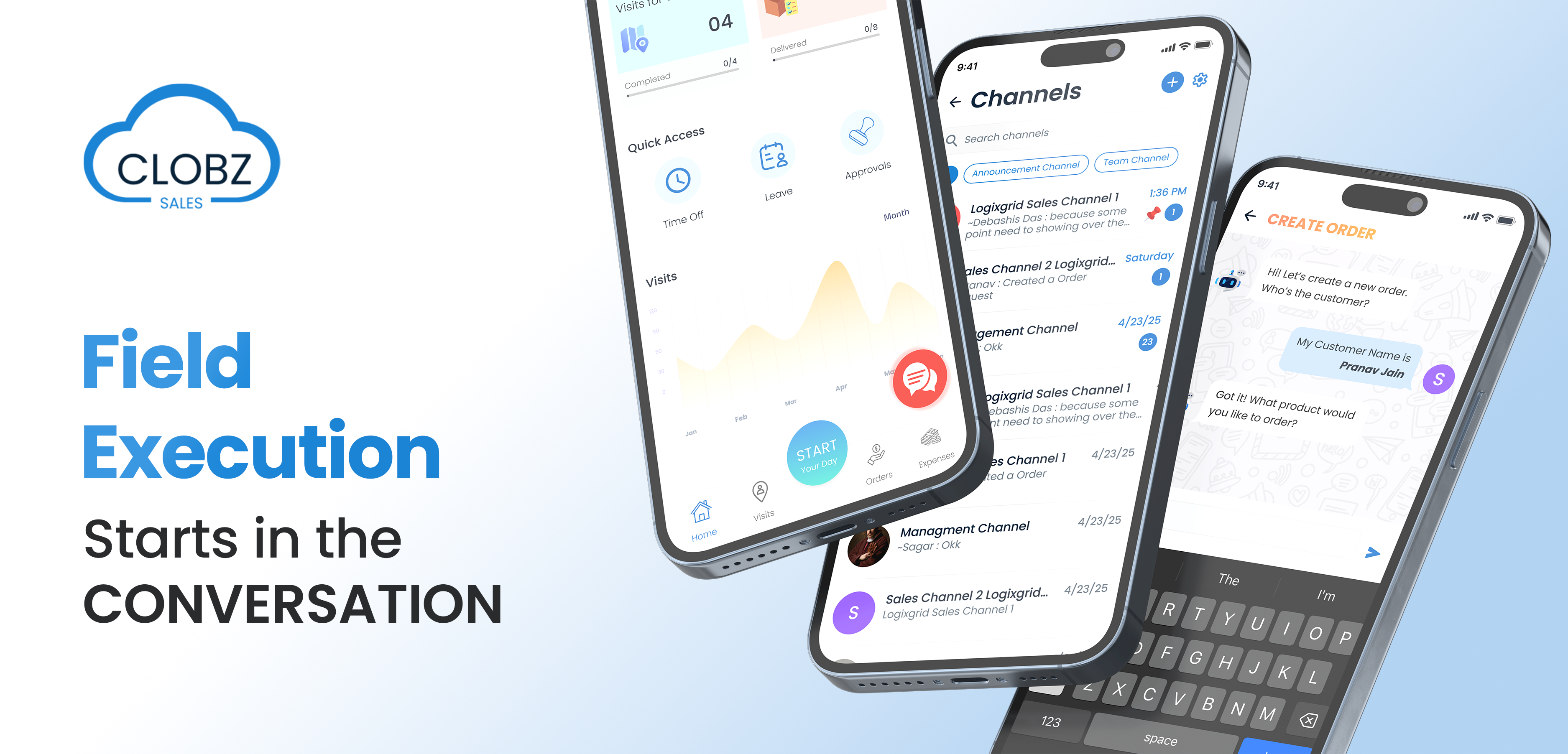
FieldTalk was designed to address a specific operational gap in field-driven organizations: the separation between communication and execution.
In most field operations, communication happens in one system and execution happens in another. Teams exchange instructions through chat, confirm orders in conversation, and share receipt photos as proof. The actual data entry follows later, often by someone else. That separation slows decisions, increases follow-ups, and makes real-time visibility difficult.
FieldTalk brings communication and execution into a single operational layer.
Conversations do not exist independently from operations. When a visit is recorded, an order is created, or a receipt is uploaded, it is captured as actionable, trackable data within the same system where communication happens.
This integration reduces coordination overhead. Field representatives no longer need to search through threads or switch between applications and managers no longer depend on individual reporting discipline to maintain visibility.
FieldTalk is built around operational control principles:
-
Actions are recorded explicitly, not assumed.
-
Updates are directly linked to customers and orders.
-
Communication produces usable data.
The result is a shift from informal coordination to controlled execution.
Businesses using FieldTalk report productivity improvements of up to 40 percent, primarily driven by reduced follow-up cycles, faster task completion, and improved managerial visibility.
FieldTalk formalizes communication into a system that supports scale.
FieldTalk as an Execution System
FieldTalk’s design centers on control, structure and visibility more than feature accumulation.
Embedded Execution Within Chat
Field representatives can execute operational tasks directly inside the conversation interface.
They can:
-
Record customer visits
-
Create and update orders
-
Upload post-order receipts
-
Share payment collection confirmations
These actions are captured as unified data instead of informal messages. No switching between applications is required. No duplication of entries in external systems is necessary.
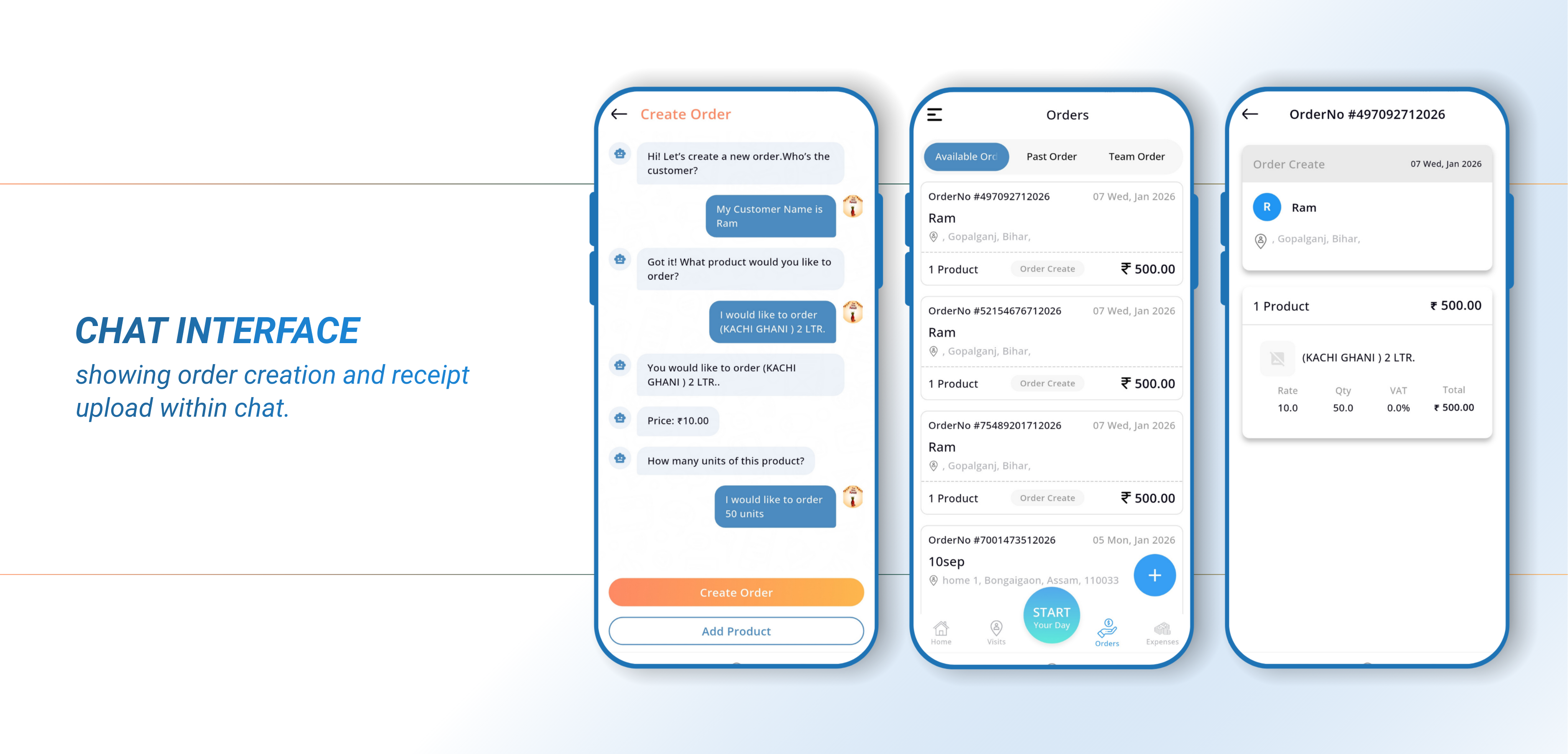
By integrating execution into communication, FieldTalk removes the disconnect between what is discussed and what is recorded.
Team Channel: Structured Collaboration for Field Teams
The Team Channel functions as a centralized operational workspace, not as a general group chat.
Inside the Team Channel, team members can:
-
Communicate in real time
-
Create and update orders directly from the conversation
-
Upload receipts and field updates linked to specific customers
For managers, the Team Channel provides a consolidated view of activity. Visits, orders, collections, and updates are organized within the system. There is no need to manually reconcile message threads or request repeated confirmations.
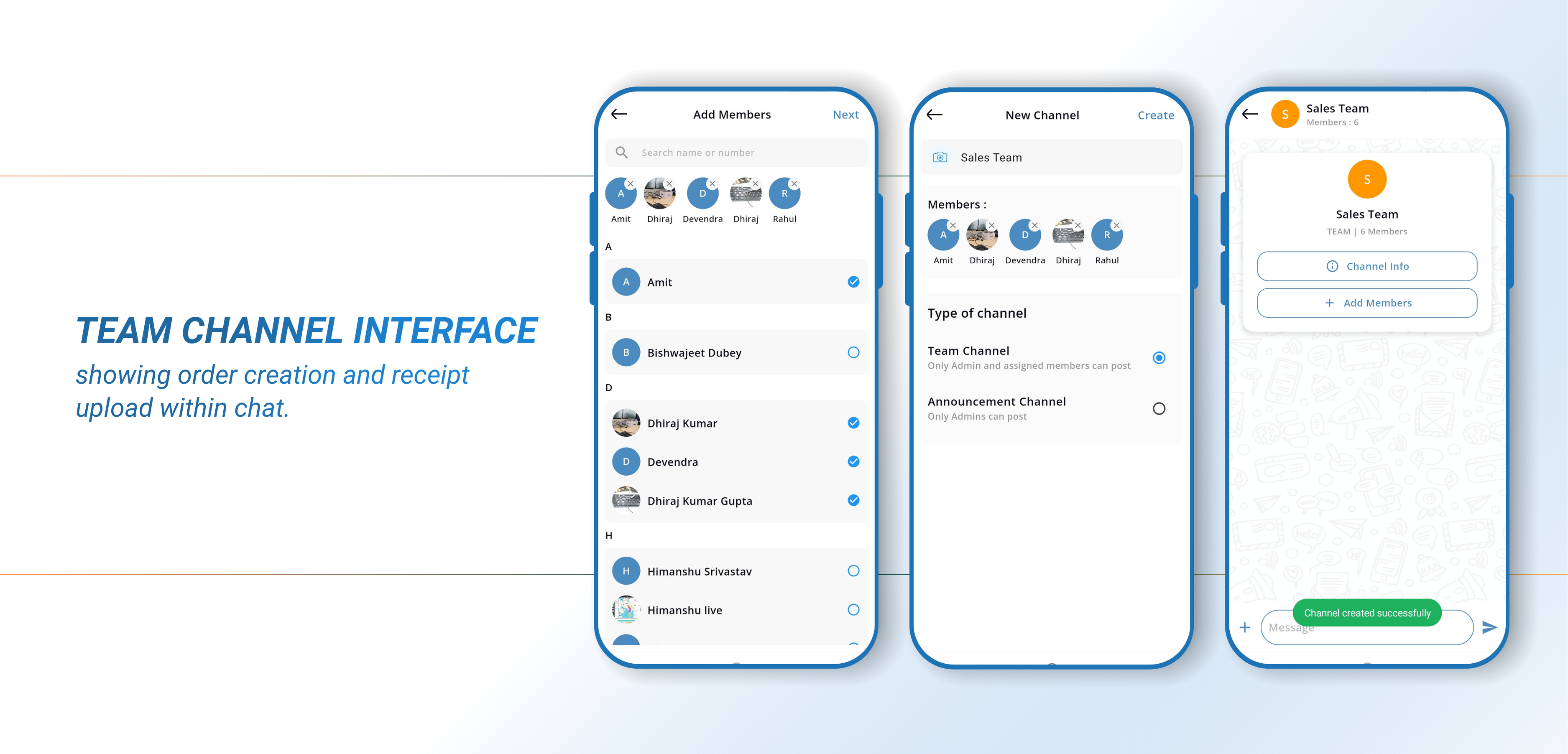
Structured replies and controlled workflows ensure that discussions translate into accountable actions.
Announcement Channel: Controlled Communication
Not every message should be part of a discussion thread. Operational clarity requires controlled broadcast communication.
The Announcement Channel provides a dedicated space for official updates. Messages shared here are typically read-only for most users, preventing fragmentation through replies and side conversations.
Organizations use the Announcement Channel to:
-
Share meeting schedules
-
Announce campaigns and offers
-
Communicate policy updates and procedural changes
Important instructions remain visible and unaltered. Field teams can identify actionable updates without searching through unrelated replies.
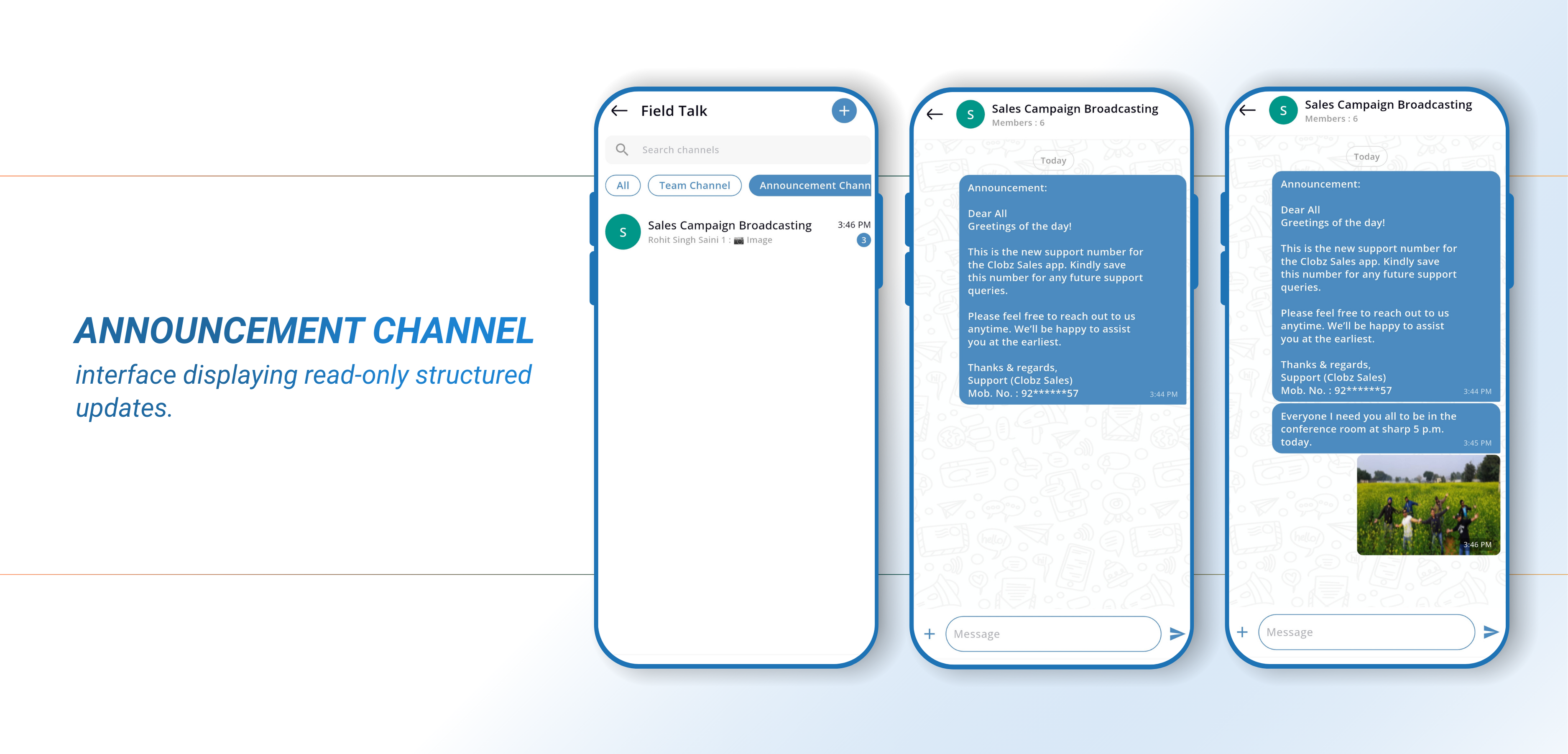
This separation between execution discussions and official communication reduces confusion and preserves accountability.
Role-Based Permissions: Governance and Control
Operational discipline requires defined authority.
FieldTalk includes role-based permissions that allow businesses to control who can perform specific actions within the platform.
Permission-based controls include:
-
Posting permissions for sensitive updates and receipt uploads
-
Administrative permissions for adding or removing team members
-
Visit and order creation permissions restricted to authorized users
This governance layer ensures that actions are performed by the appropriate personnel. It reduces the risk of inaccurate data, unauthorized changes, or misuse of access.
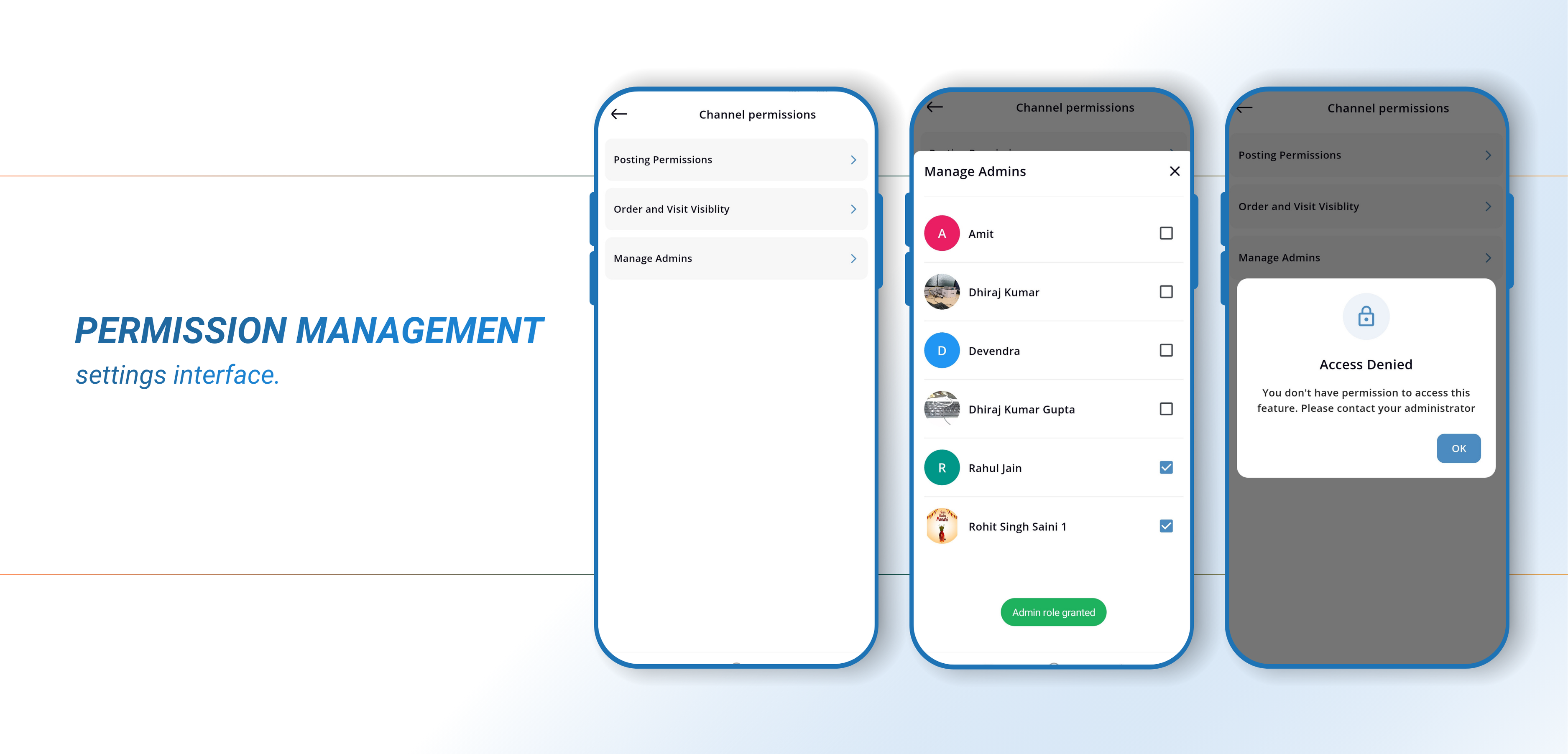
With defined roles and structured workflows, businesses retain control while allowing field teams to operate efficiently.
WhatsApp vs FieldTalk
Most companies think they have:
-
CRM
-
ERP
-
Field tracking software
But in reality, they also have a fourth system:
-
WhatsApp groups running the actual operation.
Consumer messaging applications are built for communication speed and convenience. They are effective for conversation, but they are not structured for operational accountability.
Consider a simple operational audit.
If you were asked to provide:
-
A consolidated record of yesterday’s field visits
-
Verified order updates linked to specific customers
-
Proof of payment collections with timestamps
-
Clear ownership of who created or modified each entry
Could you generate it directly from WhatsApp without manually compiling messages, screenshots, and forwarded updates?
In most cases, the answer depends on individual diligence. Information exists, but it is dispersed across threads, buried in replies, and dependent on message recall. Reconstructing a day’s activity requires manual effort and verification often depends on follow-up calls.
WhatsApp stores conversations, however it does not structure field execution into organized records.
FieldTalk captures visits, orders, receipts, and updates as system-level data at the moment of action. Each activity is timestamped, attributable, and visible within a centralized view. Managers do not reconstruct operations from memory, they review consolidated operational output.
The distinction becomes critical as teams grow, compliance requirements increase, or performance reviews demand accuracy.
The difference is not messaging speed but operational traceability.
Operational Clarity at Scale
Field operations perform best when instructions are clear, activities are traceable, and managers have reliable visibility into daily performance.
FieldTalk centralizes day-to-day field actions in the same place where communication happens. Orders are logged when confirmed and receipts are attached to actual transactions. Managers no longer depend on follow-up calls to understand performance. Businesses report productivity gains of up to 40 percent by minimizing time spent on follow-ups, message searches, and manual tracking.
FieldTalk is a communication and execution layer built specifically for field-driven organizations, not positioned as another messaging tool.
As field teams expand and compliance expectations increase, informal coordination creates instability. Systems that integrate communication with execution provide the structural foundation required for sustainable operational scale.